“Free Trade” Roundtable Organised by QBA at the Sixth Doha Forum on Democracy, Development and Free Trade
11 Apr 2006 Sheraton Hotel, Doha, Qatar
QBA Members attended
HH Sheikh Hamad Bin Khalifa Al Thani, Emir of the State of Qatar, opened the Sixth Doha Forum on Democracy, Development and Free Trade at the Sheraton Hotel on Tuesday 11 April 2006, in the presence of a distinguished gathering of officials, parliamentarians and diplomats. In an important opening address, HH the Emir spoke of the integration of democracy, development and free trade, none of which can be applied in isolation from the others. He stressed that the success of democracy in this region is not in its interest alone, but will have a tangible strategic impact on a wide geographical circle extending from it to the East and to the West. HH the Emir concluded that the region urgently needs to complete a great project it has set out on, and must pursue it without deviating from it, for its own interest and for the interest of the world as well.
The sixth session of the Forum was organised by the Planning Council, the Qatari Businessmen Association (QBA) and the Gulf Centre for Studies, in cooperation with the Permanent Committee for Organising Conferences at the Ministry of Foreign Affairs.
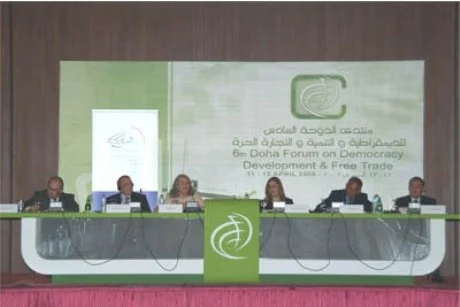
QBA organised the working session entitled “Free Trade”, which drew a distinguished, high-calibre audience. The session was chaired by Mr. Jean-Marie Péan, Partner at Bain & Company in Paris, with the participation of Dr. Sheila Page from London; Mr. Hamdi Tabbaa, President of the Arab Businessmen Union; Mrs. Carmen Gisela, Deputy Minister of Foreign Affairs of Panama; Dr. Yash Tandon, Executive Director of the South Centre in Switzerland; and Dr. Tayseer Abdel Jaber, Chairman of the Board of Investment House for Financial Services in Jordan.
The participants discussed the impact of free trade agreements on private sector companies in terms of opportunities and challenges, their impact on the structure of exports and imports and on non-trade areas, and the appropriate mechanism for implementing such agreements so as to maximise the public benefit to society.
The session chair stressed the importance of development, citing HH the Emir’s opening address that development and free trade are linked to one another.
Dr. Sheila Page spoke about free trade negotiations, noting the long time they take and that new developments and issues constantly arise, including issues raised by some small Asian countries and by countries with reservations on cotton and intellectual property.
Dr. Tayseer Abdel Jaber said that the justification offered by the World Trade Organization is the liberalisation of international trade for the common good, but the problem lies in how that common good is distributed, and whether all countries will benefit from trade liberalisation or some will be the losers in this equation. He pointed out that some 150 countries are now members of the WTO, and that these countries want their concerns to be taken seriously; otherwise free trade will not be fair trade.
Dr. Yash Tandon said that the negotiations had not achieved everything, but some things had been accomplished, which was positive. He called for special rules for agriculture, noted that the liberalisation of services had crossed the danger line and that efforts were being made in negotiations in this area, and said the problem was that small countries that do not provide services are worried about being forced to adopt certain rules.
Mrs. Carmen Gisela described the situation of the private sector in Latin American countries, which, with the exception of Chile, is very apprehensive about trade liberalisation negotiations. “When there are negotiations to liberalise trade, our thinking focuses on one idea: what will we sell in the markets that will open to us, how much will we sell, and how will we grow,” she said.
Mr. Hamdi Tabbaa affirmed that free trade agreements are not without negative aspects: they have not been fair, but rather serve the interests of the large countries and have not given developing countries sufficient opportunity to develop their economies so as to benefit fully. He pointed out that, excluding oil, Arab exports did not exceed 4% in 2004, while imports into the Arab world rose by 25%. He added that unemployment and poverty in the Arab world still worry decision makers, and that even with some 11 Arab countries joining the agreement, intra-Arab exports did not exceed 8%, half of which is oil.
In an intervention during the discussion, Mr. Haidar Murad, President of the Federation of Jordanian Chambers of Commerce, stressed that there are strong reservations among peoples towards trade liberalisation agreements, as every round of trade liberalisation negotiations is accompanied by demonstrations in the host country, which makes it necessary to reassure people and convince them of the benefits of trade liberalisation.