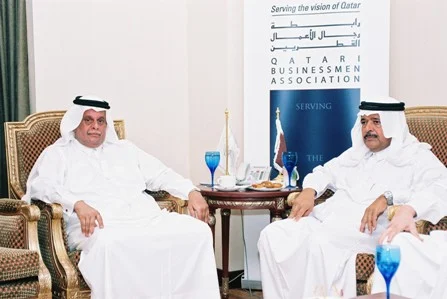
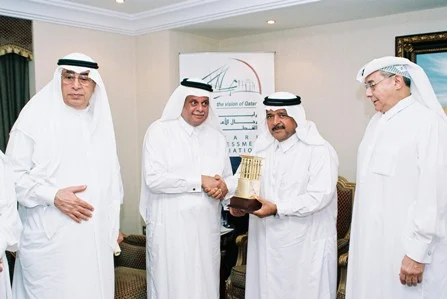
Visit of HE Abdullah Bin Hamad Al Attiyah, Second Deputy Prime Minister and Minister of Energy and Industry, to QBA
01 Mar 2006 QBA Headquarters, Doha, Qatar
QBA Members attended
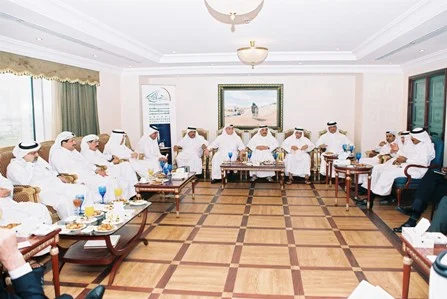
The Qatari Businessmen Association (QBA) received at its headquarters HE Mr. Abdullah Bin Hamad Al Attiyah, Second Deputy Prime Minister and Minister of Energy and Industry, for an open and frank dialogue, marked by candour and transparency, to exchange views on the role of the private sector in development plans and programmes.
The meeting was attended by Sheikh Faisal Bin Qassim Al Thani, Chairman of QBA, Mr. Hussain Al Fardan, Mr. Issa Abu Issa, Board members Mr. Abdullah Bin Nasser and Mr. Omar Al Mana, and members Mr. Nasser Rashid Al Kaabi, Mr. Sherida Al Kaabi, Sheikh Abdullah Bin Ahmed Al Thani, Mr. Khalid Al Rabban, Mr. Ibrahim Al Neama, Mr. Maqbool Habib Khalfan, Mr. Abdullah Mohammed Al Ibrahim Al Mannai, Mr. Ibrahim Al Jaidah, Sheikh Nasser Bin Hamad Khalid Al Thani, Mr. Khalifa Abdullah Al Suwaidi and Mr. Ali Abdulredha Abdullah Mashhadi, as well as Mr. Bassam Ramzi Massouh, General Manager of QBA, and a large gathering of journalists and media representatives.
Mr. Hussain Al Fardan, Vice Chairman of QBA, opened the meeting by thanking HE the Second Deputy Prime Minister for accepting the invitation. He affirmed that the role of the Association is to prepare future visions that converge with the vision of the Ministry of Energy and Industry for the administrative and operational development of private sector companies, qualifying them to compete on the principles of the open market and to rely on their own effectiveness.
He added that the economy of any country is built essentially on the combined efforts of the public and private sectors, regardless of the contribution of each; in open economies the private sector plays a fundamental role in supporting the national economy, while the role of the public sector is to develop and regulate the policies and laws governing the economy. Al Fardan stressed that the Association, in working to develop local companies so that they add value in a free economy and play their role in supporting the public sector over the long term, seeks to benefit from the experience of the Ministry of Energy and Industry in restructuring, preparing the necessary strategies and supporting local companies on the basis of mutual trust and guaranteed quality of local output. Beyond the results expected from this communication and support, he said, the private sector would shortly become a fundamental tributary of the national economy.
For his part, HE the Second Deputy Prime Minister addressed the issues to which the Ministry of Energy and Industry attaches particular importance regarding the role of national private sector companies and institutions in oil, gas, petrochemical, energy and other projects. This stems from the Ministry’s conviction of the positive role this sector plays and its keenness for the sector to develop and adapt itself to the requirements of the industry, with the high technical, administrative and financial competence it demands, so that it can compete deservedly with regional and international companies.
HE affirmed that the Ministry looks forward to a strong private sector capable of achieving further progress and prosperity for national industry and enhancing its contribution to comprehensive economic development. “While the private sector has proven in the past its ability to contribute substantially to energy and industry projects, I see much wider horizons for this sector to increase its contribution to future projects, given the diversity and number of these projects and the size and quality of the expertise the private sector has accumulated, which now better qualifies it to take part in the broad range of activities these projects involve,” he said.
Sheikh Faisal Bin Qassim Al Thani, Chairman of QBA, affirmed that the Association works to develop the activity of the private sector, coordinates between state ministries and institutions and businessmen, and provides them with advice and guidance in order to develop business and strengthen the role of the private sector in the national economy, serving as a link with government bodies. Sheikh Faisal said that most major investors are currently turning to real estate and equities, and that the state must support these trends so that these companies can develop their activities and withstand competition. He explained that if major investors are not supported, the market will suffer. Sheikh Faisal praised the outcome of the meeting, namely the formation of a joint committee of the Ministry of Energy and the Association to study the available opportunities and coordinate the resolution of obstacles.
During the open meeting, the private sector raised a number of key issues for discussion with HE the Second Deputy Prime Minister:
- HE’s vision of the role of the private sector and its contribution to economic growth and the comprehensive development of the State of Qatar.
- Ways in which state companies operating in oil, gas and petrochemicals can support private sector companies and institutions.
- The future of national industries and the tools for attracting private sector investment into industrial fields.
- The role of the Qatari Businessmen Association in developing the capabilities of the private sector, and HE’s guidance on the Association’s future activities.
- Current affairs.
The consultative meeting concluded with the formation of a joint committee to activate the role of the private sector in the coming phase. The meeting was positive: HE the Second Deputy Prime Minister affirmed the opportunities the Ministry of Energy offers to support the private sector, and said there was a plan to establish a large services company, in the form of a holding company, comprising Gulf Helicopters, Al Koot Insurance and Gulf Drilling, of which 60% would be offered to the private sector through privatisation.
In addition, a small committee was formed comprising senior officials of the Ministry of Energy and Industry and members of the Association to define the points discussed, learn about businessmen’s ideas, views and observations, identify their present and future needs, and determine how to implement them.
Photo gallery (2)