|
|
|
|||||||
|
|
||||||||
|
|
||||||||
|
QATAR HOISTS EIGHT STEPS UPWARDS ON THE RANKINGS OF THE WORLD’S COMPETITIVENESS SCALE |
||||||||
|
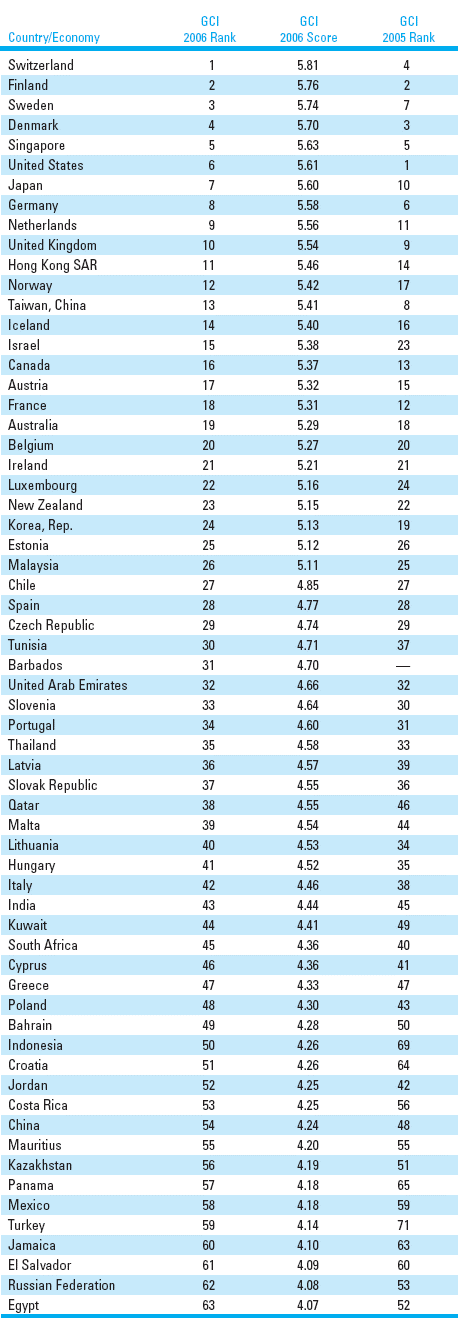
Qatar moved up eight places to rank 38th on the Global Competitiveness Index that is declared in the World Economic Forum’s annual report for this year. Qatar scored a competitiveness record of 4.55 this year, which qualified the state to jump from number 46 in 2005 up to number 38 among a total of 125 countries covered by this year’s Global Competitiveness Report (GCR). According to the report, terms-of-trade gains linked to oil prices have boosted growth rates and reinforced already high levels of confidence in the business community, resulting from ongoing institutional modernization and improvements in macro-economic management.
The Report contains a detailed country/economy profile for each of the 125 economies featured in the study, providing a comprehensive summary of the overall position in the Index rankings as well as a guide to what are considered to be the most prominent competitive advantages and competitive disadvantages of each. Also included is an extensive section of data tables with global rankings covering over 100 indicators.
The rankings are drawn from a combination of publicly available hard data and the results of the Executive Opinion Survey, a comprehensive annual survey conducted by the World Economic Forum (WEF), together with its network of Partner Institutes in the countries covered by the Report. Qatari Businessmen Association (QBA) is the local partner of WEF and is proud to put massive efforts to distribute, follow up and collect the survey questionnaire, which is designed to capture a broad range of factors affecting the economy expressed by the views of the whole business community. Qatari Businessmen association annually helps the WEF to deliver a comprehensive overview of the main strengths and weaknesses in the national economy, making it possible to identify key areas for policy formulation and reform.
“With the growing complexity of the global economy, The Global Competitiveness Report is a contribution to enhancing our understanding of the key factors which determine economic growth. By providing detailed assessments of the economic conditions of Qatar and other nations worldwide, the Report offers policy-makers and business leaders an important tool in the formulation of improved economic policies and institutional reforms," noted Sheikh Faisal, Chairman of Qatari Businessmen Association.
This year marks an important progression in The Global Competitiveness Report’s methodology, with the adoption of a new, more comprehensive, tool to assess countries’ competitiveness: the Global Competitiveness Index (GCI). The introduction of the Global Competitiveness Index is a logical extension of the World Economic Forum’s competitiveness work. Changes in the global economy and the increasing complexity which characterize the business environment have made it necessary to develop an instrument that captures a larger set of factors affecting the evolution of economic growth.
The top rankings of Switzerland Finland and Sweden show that good institutions and competent macroeconomic management, coupled with world-class educational attainment and a focus on technology and innovation, are a successful strategy for boosting competitiveness in an increasingly complex global economy. Business activity in these countries benefits from a well-developed institutional framework, characterized by the rule of law, an efficient judicial system and high levels of transparency and accountability within public institutions. Excellent infrastructure is an additional positive feature of the business environment. Our indicators point to the rapidly growing importance of higher education and training as engines of productivity growth.
Detailed information of this year’s GCR mark the movements up or downwards for some countries, while some others maintained their position on the index. The United States, previously in first place, continues to enjoy an excellent business environment, efficient markets and is a global centre for technology development. However, its overall competitiveness is threatened by large macroeconomic imbalances, particularly rising levels of public indebtedness associated with repeated fiscal deficits. Its relative ranking remains vulnerable to a possible disorderly adjustment of such imbalances, including historically high trade deficits.
Leading within Asia are Singapore and Japan, ranked 5th and 7th respectively, closely followed by Hong Kong (11) and Taiwan (13). These economies are characterized by high-quality infrastructure, flexible and efficient markets, healthy and well-educated workforces and high levels of technological readiness and innovative capacity. Malaysia, ranked 26th overall, has one of the most efficient economies in the region with flexible labour markets, relatively undistorted goods markets and public institutions which in many areas (e.g., rule of law, the legal system) are already operating at the level of the top performing new EU.
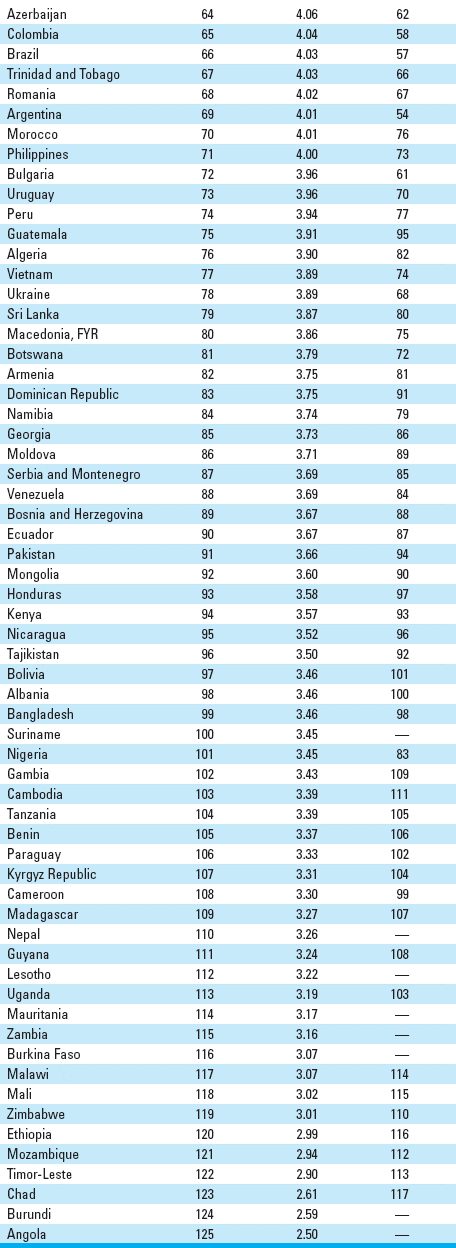
Within the Middle East and North Africa (MENA) region, the Gulf States continue to perform quite well in the overall GCI rankings. Tunisia ranked 30th, United Arab Emirates (UAE) ranked 32nd, Qatar 38th, Kuwait 44th, and Bahrain 49th. In many of the resource-rich countries, the availability of public finance appears – at least for now – not to have translated into improvements in human capital, which would play an important role in helping these economies that are highly dependent on oil and vulnerable to external shocks to diversify their economic base.
Algeria (76) and Morocco (70) improved remarkably from last year, thanks in part to significant improvements in institutions. Egypt dropped nine ranks to 63rd this year, due to an extremely sharp drop of 58 places to rank 108 in the macro-economy pillar, as it struggled with worsening government finances and a large debt ratio. It also fell back in the areas of higher education and training and innovation.
|
|
|||||||
|
||||||||